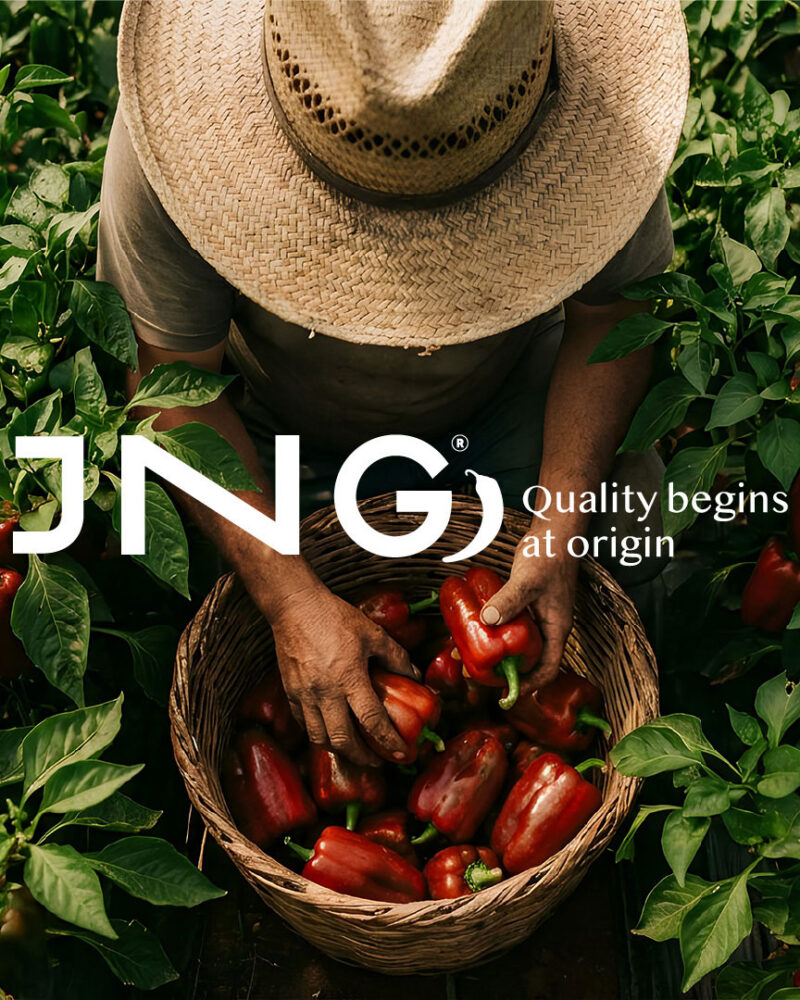
Regenerative Agriculture: Quality begins in the field.
Une meilleure origine. Un meilleur résultat. Pour JNG, l’agriculture régénératrice n’est ni une tendance, ni une certification, ni une promesse marketing. C’est une autre façon de produire : C’EST UNE AUTRE FAÇON DE CULTIVER.
The quality of an ingredient begins long before it reaches the food industry. It starts in the field, with soil conditions, crop management, and the decisions made throughout the agricultural production process.
At Juan Navarro García (JNG), we believe that moving toward a more sustainable production model also means strengthening the quality, traceability, and consistency of the raw materials we supply to our customers.
That is why we work closely with our growers to support a gradual transition toward regenerative agriculture practices, combining technical expertise, innovation, and more efficient management of natural resources.
What Is Regenerative Agriculture and Why Does It Matter?
Regenerative agriculture is an approach to farming that aims to improve soil health, promote biodiversity, and strengthen crops’ ability to adapt to their growing conditions.
Unlike other approaches that focus primarily on reducing environmental impact, regenerative agriculture seeks to progressively improve the natural conditions that support agricultural production.
For JNG, it represents an evolution in how we operate at the source, with a clear objective: to help develop more resilient crops and a more stable, consistent supply of raw materials.
This transition requires knowledge, monitoring, and adaptability. Every agricultural operation has its own characteristics, which means farming practices must be tailored to the needs of each crop and growing region.
From Soil Health to Paprika Quality
Soil is one of the most essential resources in agricultural production. Its structure, fertility, and ability to manage water and nutrients directly influence crop development.
At JNG, we work alongside our growers to make progress in three key areas:
- Soil health: supporting long-term soil fertility, biodiversity, and productivity.
- Precision agriculture: incorporating agronomic expertise, data analysis, and crop monitoring to support better-informed decisions.
- Resource optimization: promoting more efficient agricultural management practices tailored to the conditions of each farming operation.
These initiatives aim to strengthen crops from the ground up and contribute to greater stability and uniformity in raw material quality.
In the food industry, where consistency and quality are critical, working directly at the agricultural source helps build a supply chain that is better equipped to meet market requirements.
Sustainability, Innovation, and Technical Expertise
The transition toward regenerative agriculture does not depend on a single practice or a one-size-fits-all solution.
It requires collaboration among growers, agricultural technicians, and specialists, along with ongoing monitoring and evaluation.
At JNG, we see agricultural innovation as a tool for improving processes at the source. Soil analysis, crop monitoring, and the evaluation of farming practices help identify opportunities for improvement and guide decisions throughout each growing season.
Measuring, analyzing, and improving are essential to our approach to sustainability.
This collaborative effort also aims to help our growers develop more efficient, profitable agricultural operations that are better prepared to meet future challenges.
A Commitment That Extends Across Our Operations
Our approach to sustainability goes beyond agricultural production.
At JNG, we incorporate environmental, social, and governance considerations into different areas of our business, from supplier selection to our own production processes.
We follow responsible sourcing principles, prioritizing stable, long-term relationships with suppliers who share our standards for quality and traceability.
We are also advancing the assessment of environmental, social, and governance factors throughout our supply chain.
Reducing our environmental footprint is another key priority. As part of this commitment, we have developed a Decarbonization Plan based on an analysis of our emissions. This plan helps us identify opportunities for improvement and establish a progressive approach to reducing emissions.
We view these commitments as part of an ongoing improvement process, guided by realistic objectives and regular progress assessments.
More Responsible Sourcing for an Increasingly Demanding Industry
Sustainability also creates opportunities to deliver greater value to our customers.
The food industry requires raw materials that meet high quality standards, along with suppliers that can provide reliability, traceability, and continuity of supply.
Our work at the source is designed to support these goals through more rigorous agricultural management, more resilient crops, and a deeper understanding of the raw materials we source.
For paprika and its derivatives, this approach reinforces our commitment to the consistency and quality of the ingredients we supply to the food industry.
It also allows us to support our customers’ own sustainability commitments by progressively integrating responsible practices throughout the value chain.
Growing the Future Starts Today
At Juan Navarro García, our history dates back to 1865. This experience has taught us that quality is built through expertise, commitment, and continuous improvement.
Today, that same philosophy drives us to keep moving toward a more efficient, resilient, and responsible agricultural production model.
Regenerative agriculture is part of that journey. It is a transition we are pursuing alongside our growers, combining experience, innovation, and technical knowledge.
Because caring for the source also means protecting the quality of what comes next.